

MBA (CAT + OMETs) 19 October 2026
 12 min read
How Long Does CAT Preparation Take? 3, 6, and 12-Month Plans
How long does CAT preparation take? Compare 3, 6, 9, and 12-month plans with weekly study hours, mock test targets, preparation phases, and checkpoints to choose a realistic CAT 2027 strategy.
19 October 202612 min read
Key takeaways
- How long CAT preparation takes: Plan about 12 months from scratch, 9 months on a compressed plan, 6 months with a working base, and 3 months only for revision and mocks. These need about 10 to 14, 14 to 18, 18 to 22, and 28 or more hours a week.
- Total hours: Total hours equal weekly hours × weeks, so 6 months at 15 hours a week is roughly 390 hours. Hours matter more than months.
- Mocks and checkpoints: Full CAT preparation includes around 25 to 30 analysed mocks, with one mock every 7 to 10 days in the final phase. Each plan has four checkpoints with a pass or fail test.
- Timing and the 99+ percentile: CAT registration closed on 22 September , so anyone starting now is preparing for CAT 2027, expected in late November 2027. A 99+ percentile depends on starting level, weekly hours, and mock count together, and no plan guarantees it.
One holds a steady weekly routine and reviews every mock line by line. The other studies in bursts and treats mocks as a score check.
CAT is the entrance exam for MBA programmes at the Indian Institutes of Management (IIMs). The calendar alone cannot tell you whether you are ready for it. Weekly hours, the mocks you analyse and your starting level decide that, and a range of months hides all three.
Most advice on timing stops at that range, which leaves you guessing whether you are on track. This page gives each timeline as a plan you can check: weekly hours, total hours, mock cadence and a monthly checkpoint. Pick a row, run the checks, and within a month you will know whether the plan is holding.
How long does it take to prepare for CAT?
Plan about 12 months if you are starting from scratch, about 6 months if you already have a working base, and 3 months only to revise that base and take mocks. Rodha's recommendation is 8 to 12 months from scratch. The tables below plan for the 12-month end because it leaves room for weeks that slip. With under 4 months to the exam and no base, join a crash course instead.
The measure is hours, not months. Use this formula: total hours = weekly hours × weeks. A month is about 4.3 weeks, so 6 months is roughly 26 weeks.
| Weekly hours | Weeks | Total hours |
| 8 | 26 | 208 |
| 15 | 26 | 390 |
| 20 | 26 | 520 |
This is our planning model, not an official figure. The same six months can mean 208 hours or 520.
The three sections are Quantitative Aptitude (Quant), Data Interpretation and Logical Reasoning (DILR, also written LRDI) and Verbal Ability and Reading Comprehension (VARC).
Analysed mock: On this page, a full-length mock test after which you log every wrong or skipped question and its cause before you take the next one.
Is it too late for CAT, and what does that make CAT 2027?
If you have not registered, it is too late for CAT . Registration for CAT closed on 22 September after IIM Indore extended the original 15 September deadline. Read the extension notice and confirm dates at iimcat.ac.in. IIM Indore conducts the exam on 29 November . CAT 2027 is expected in late November 2027, so anyone starting now has about 12 months.
If you are already registered for CAT , the weeks left do not suit a first pass through the syllabus. Spend them on analysed mocks and on repairing your weakest section. The last section of this page points you to the right route.
How many months of CAT preparation do you need, and what does each plan demand?
Twelve months needs about 10 to 14 hours a week, six months about 18 to 22, and three months 28 or more. These are our recommended weekly hours. They count focused, protected study time only, which is why they run lower than the daily figures some guides quote, and the checkpoints below catch a plan that is slipping. Each row assumes a different starting point, and shorter rows leave less room to repair a weak section.
| Plan | Assumes | Weekly hours | Weeks | Total hours |
| 12 months | Starting from scratch or a weak base | 10 to 14 | 52 | 520 to 728 |
| 6 months | A working base in at least two of the three sections | 18 to 22 | 26 | 468 to 572 |
| 3 months | A base in all three sections; revision and mocks, not first-time learning | 28 or more | 13 | 364 or more |
Total hours are weekly hours × weeks: 10 × 52 = 520, 14 × 52 = 728, 18 × 26 = 468, 22 × 26 = 572, 28 × 13 = 364.
Our beginner's guide suggests one to two hours a day, or 7 to 14 hours a week, for college students in the foundation stage. This plan asks for the upper half of that range, 10 to 14 hours, because it also has to fit sectional tests and 25 to 30 analysed mocks.
Our beginner's guide recommends around 25 to 30 quality mocks in total for full preparation, and one mock every 7 to 10 days in the mock-driven phase. The table shows what that cadence yields in each plan's mock-driven phase (months 9 to 12, 5 to 6 and 3).
| Plan | Mock-driven weeks | Mocks at one per 7 to 10 days | What you give up |
| 12 months | 17 | 12 to 17 | Nothing structural, but you commit hours every week for 52 weeks |
| 6 months | 9 | 6 to 8 | Slack. A missed fortnight comes out of mock time, and the weakest section gets less repair time |
| 3 months | 4 | 3 to 4 | New learning. Topics you do not already know stay unknown |
We worked these out as mock-driven weeks × 7 days ÷ (7 to 10 days per mock), rounded down. For 12 months, 4 months × 4.3 weeks = 17.2 weeks, which gives 12.0 to 17.2 mocks. For 6 months, 2 × 4.3 = 8.6 weeks gives 6.0 to 8.6. For 3 months, 1 × 4.3 = 4.3 weeks gives 3.0 to 4.3.
On the 12-month plan, the rest of the 25 to 30 comes from full mocks taken during the sectionals phase. On a 6-month or 3-month plan, the number you can analyse properly is set by the weeks left.
Each checkpoint is a test with a pass or fail result. The thresholds and month positions are our recommendation. Section balance matters because IIMs set a sectional cutoff, the minimum score required in each section separately, besides the overall score.
| Checkpoint | 12 months | 6 months | 3 months | Pass test |
| Foundation complete | End of month 4 | End of month 2 | End of month 1 | At least 70% correct on untimed topic sets in all three sections |
| Sectional tests running | From month 5 | From month 3 | From month 2 | At least one sectional test a week, rotating sections, each followed by a logged error review |
| Sectional balance | End of month 8 | End of month 4 | End of month 2 | Your lowest sectional percentile is no more than 10 points below your best |
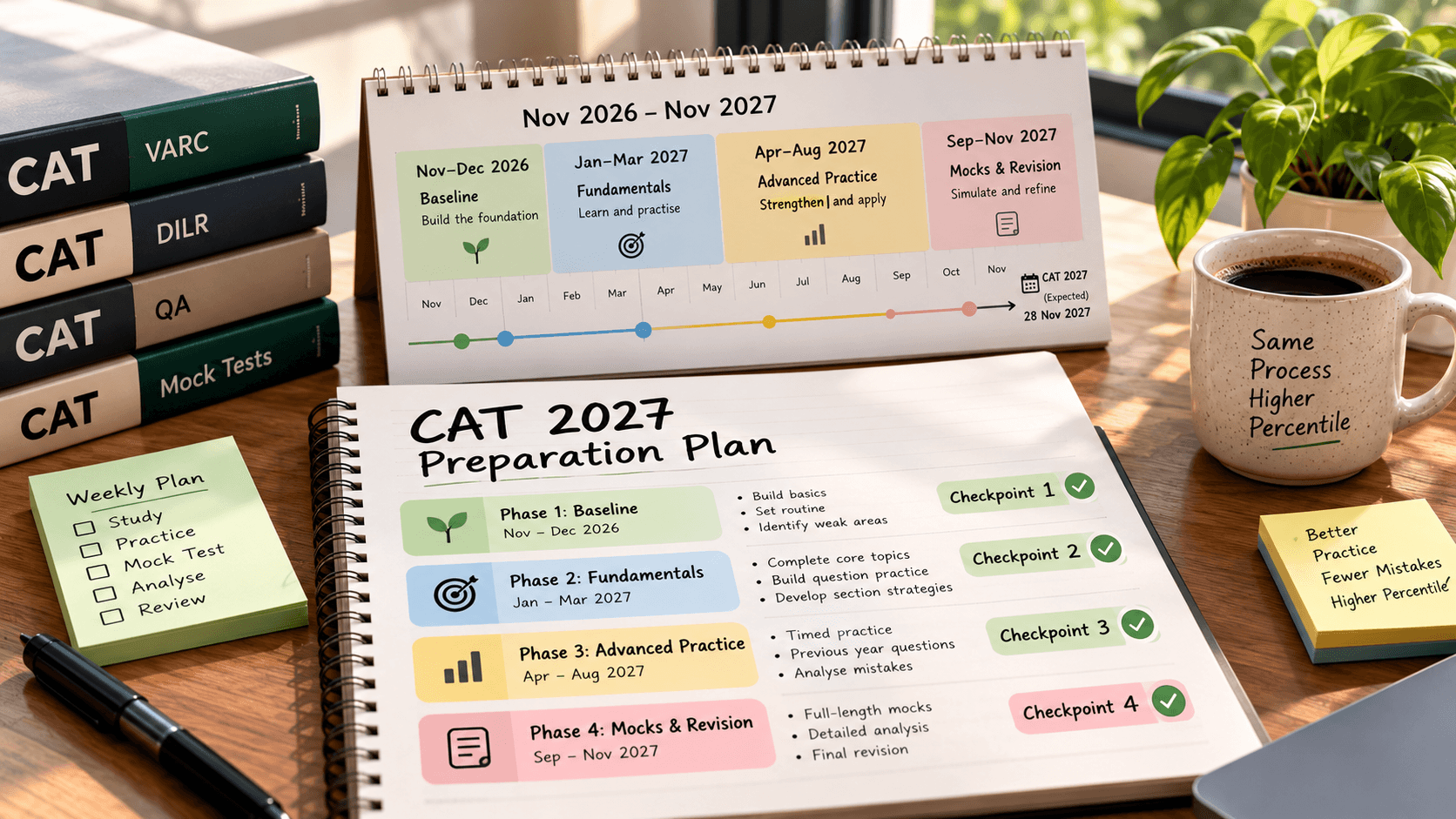
| Mock-driven phase starts | Month 9 | Month 5 | Month 3 | A full mock every 7 to 10 days, each analysed before the next |
Start-date mapping
| If you start | Time to CAT 2027 (expected late November 2027) | Row to use |
| Now, in October | About 12 months | 12 months |
| Around late February 2027 | About 9 months | 9 months (the 12-month plan, compressed) |
| Around May 2027 | About 6 months | 6 months |
| Around August 2027 | About 3 months | 3 months, with a prior base only |
The 9-month row is the 12-month plan compressed. It suits a candidate who would be on the 12-month row but has about nine months. Plan about 14 to 18 hours a week for 39 weeks, which is 546 to 702 hours (14 × 39 = 546, 18 × 39 = 702).
Run foundation in months 1 to 3, sectional tests from month 4, the sectional balance check at the end of month 6 and the mock-driven phase from month 7. That phase yields about 9 to 13 analysed mocks (13 weeks × 7 days ÷ 7 to 10 days per mock).
Use the same pass tests as the checkpoint table above. These are our planning figures, set between the 12-month and 6-month rows. If you start later than August 2027 without a base, use a crash course.
Which timeline fits a fresher, a working professional, a repeater or a non-engineer?
Freshers and non-engineers start on the 12-month row. Working professionals choose by the weekly hours they can protect. Repeaters with a score report can use the 3-month row. Run three checks to confirm. The slowest result sets your row.
- Mock check. Sit one timed full mock this week. Percentiles differ between mock series, and some are deliberately harder, so use the same series for every check and treat the result as a guide, not a verdict. If you have never taken a mock, or you land below the 70th percentile, you are on the 12-month row. From the 70th percentile up to below the 90th, you are on the 6-month row. At the 90th percentile or above, the 3-month row is open to you if the other two checks also pass. Percentile is the share of test-takers you outscored; CAT score vs percentile shows the conversion.
- Hours check. Log one ordinary week of focused study. If it falls below the weekly hours of your row, move to the longer row. Below 10 hours a week, no row holds, so raise the hours or extend the horizon.
- Quant check. Solve a 20-question untimed arithmetic and algebra set at Class 10 level without notes. If you get fewer than 10 right, you are on the 12-month row whatever the other two checks say.
| Profile | Row | What decides it |
| Fresher | 12 months | Plan 10 to 14 hours a week, the upper half of the one to two hours a day our guide suggests for college students |
| Working professional | 12 months, or 6 months at 18 or more hours a week | Protected weekly hours. Ninety focused minutes a day, about 10.5 hours a week, beat four distracted hours. For depth, see CAT online coaching for working professionals. |
| Repeater | 3 months, if your last score report names your weak section | A base and a score report already exist |
| Non-engineer | 12 months | Quant pace. See CAT coaching for non-engineers |
A worked example: 2 to 3 hours on each of six days (Monday to Saturday) is 12 to 18 hours; a five-hour Sunday makes 17 to 23. That only covers the 6-month row if you keep every day. If you miss days, plan on the 12-month row.
How have Rodha students' timelines looked?
Rodha's published CAT 2025 journeys include IIM Ahmedabad results reached in about 5 and 6 months. They are examples, not benchmarks: one student's path does not set your timeline, so match yourself to a row using the three checks above.
| Student | Result | Timeline | Source |
| Shriya Yadav | 99.18 percentile, IIM Ahmedabad, CAT 2025 | About 5 months, first attempt | Rodha CAT results |
| Siddhant Misra | 99.97 percentile, IIM Ahmedabad, CAT 2025 | About 6 months | Rodha CAT results |
A 5 or 6-month result sits at the length of the 6-month row, and that row assumes a working base. These journeys therefore do not show that a 6-month plan works from scratch. Each student's starting level and weekly hours are their own, so use the checks above, not these results, to choose your row.
How do foundation, sectionals and mocks fit inside each timeline?
All three plans run the same three phases in the same order, and each phase takes one third of the plan, whatever its length. The checkpoint table and the start-date table give the month positions. Our beginner's guide explains each phase in full. This table shows what to work on in each one, and adds the final revision weeks, which sit at the end of the mock-driven phase.
| Phase | What to work on |
| Foundation | Concepts without time pressure, a daily reading habit, light DILR exposure. Avoid full-length mocks and speed drills. On the 3-month plan this is revision, not first-time learning. |
| Sectionals | Sectional tests introduced slowly, mixed-topic practice, error tracking by question type. |
| Mock-driven | A full mock every 7 to 10 days with deep analysis after each, plus previous-year CAT papers solved under timed conditions. |
| Final revision (last three weeks of every plan) | Formulas, your error log and your question-selection strategy. Start no new topics. |
How should you split your weekly hours across the three sections?
Start with an even split across Quant, DILR, and VARC. After your first sectional balance check, move hours toward the section with your lowest percentile until it is within 10 points of your best, the same test as in the checkpoint table.
How do you know your CAT study plan is off schedule, and what is the 99+ reality?
Your plan is off schedule when a checkpoint fails twice in a row, or when your scores in a section stay flat across your last three analysed mocks. Those limits are our recommendation. A flat score usually points to a concept gap, so more mocks will not fix it.
When should you extend the plan?
Extend when your error log points to concepts, not speed. Run these tests:
- Concept test. Open your last three error logs. If the same question type appears in all three, the concept is not fixed. Add weeks to foundation work in that section and push the mock-driven phase back. For more on reading a flat score, see our guide to low mock scores.
- Pacing test. If you leave more than a quarter of a section's questions unattempted in three consecutive sectional tests, add one extra sectional a week for that section. Stop once two tests in a row fall below that line.
- Carelessness test. The next day, re-attempt your wrong answers untimed. If you solve more than a third of them, the loss was carelessness, not concept. Slow your first pass on those question types and add a final check before you submit.
When should you switch to a crash course?
Switch when fewer than 4 months remain, and your foundation checkpoint is still unpassed. A long plan's foundation phase no longer fits that window. A crash course prioritises the highest-yield areas and moves quickly to mocks; our 60-day crash-course plan shows how that window is used.
What does a 99+ percentile demand?
A timeline reaches 99+ only if starting level, weekly hours and mock count all hold. A 99+ percentile means you outscored 99 of every 100 test-takers, so any shortfall in those three costs you.
Shorter timelines raise the bar on all three. A 3-month plan can only get there for a candidate whose base is already strong, who holds 28 or more hours a week and who analyses every mock the weeks allow. Plan for the effort with no skipped weeks, and judge the plan by the checkpoints, not by a promised result.
Which Rodha CAT 2027 batch matches your timeline?
For the 12-month, 9-month and 6-month rows, start with the CAT 2027 courses. The CAT 2027 Hinglish Comprehensive Batch (Hinglish is a mix of Hindi and English) covers Quant, LRDI and VARC from basics to advanced; the course page lists what each batch includes. If one section is your gap, the Quant, LRDI and VARC batches are sold separately. The course page shows current pricing and payment options. With under four months to go and no base, choose the crash course listed on the same page.
If you are registered for CAT and have only weeks left, the CAT portal lists our boosters for that window.
Sources
- CAT official site, IIM Indore: exam date and registration.
- CAT registration deadline extension, Rodha: the 22 September deadline.
- CAT preparation for beginners, Rodha: phases, mock count and cadence, daily hours.
- Overcoming low mock scores, Rodha: reading a flat score.
- CAT 2027 courses, Rodha: batch contents.
- CAT portal, Rodha: boosters.
- Rodha results and student journeys: published timelines.
Frequently asked questions
Is 3 months enough for CAT?
Only if you already score around the 90th percentile on a timed mock, and only for revision and mocks. Three months leaves about four mock-driven weeks, so a weak section cannot be rebuilt in that time.
Can I crack CAT in 6 months?
Yes, if a mock already puts you between the 70th and 90th percentile and you hold 18 to 22 hours a week for all 26 weeks. That is 468 to 572 hours. A candidate below that level needs the 12-month plan.
How many hours a day for CAT?
About 1.5 to 2 hours a day on the 12-month plan, about 2 to 2.5 on the 9-month plan, about 3 on the 6-month plan, and 4 on the 3-month plan, found by dividing weekly hours by seven. Weekend blocks can carry part of the weekly total.
Can I prepare for CAT while working?
Yes, on the 12-month row if you can protect 10 to 14 hours a week, and on the 6-month row only if you can hold 18 or more. Fix your study slots in the calendar, because a missed week costs more on shorter plans.
Is 12 months too long to prepare for CAT?
No. Twelve months is the plan for a candidate starting from scratch, and the risk is drift, not length. The four checkpoints give you a monthly test of whether the plan is holding.
Can I prepare for CAT without coaching?
Yes, if you hold the weekly hours, analyse a mock every 7 to 10 days in the final phase and keep your own error log. Coaching adds a fixed schedule, faculty feedback and question banks; it does not replace the hours.
Is 9 months enough for CAT?
Yes, if you put in 14 to 18 hours a week for about 39 weeks, which is 546 to 702 hours, and run the 12-month phases in a shorter span. It suits a candidate who would otherwise be on the 12-month row but has about nine months. A weak section has less time to repair, so check the foundation checkpoint at the end of month 3.
Pick the Rodha CAT 2027 batch that fits your timeline
Start with the CAT 2027 courses, or write to contactus@rodha.co.in for help choosing.
Related Posts

MBA19 Oct 20269 min read
CAT Score Calculation: Marks, Attempts, Accuracy and Percentile (2026 Pattern)
19 Oct 20269 min read


Ready to Take the Next Step?
Explore our programs or connect with Rodha Buddy for personalised guidance.
