

MBA (CAT + OMETs) 19 October 2026
 10 min read
CAT 2027 Preparation Plan: Month-by-Month Roadmap With Checkpoints
Prepare for CAT 2027 with a month-by-month roadmap covering fundamentals, advanced practice, mock tests, weekly study hours, progress checkpoints, and a six-month preparation plan.
19 October 202610 min read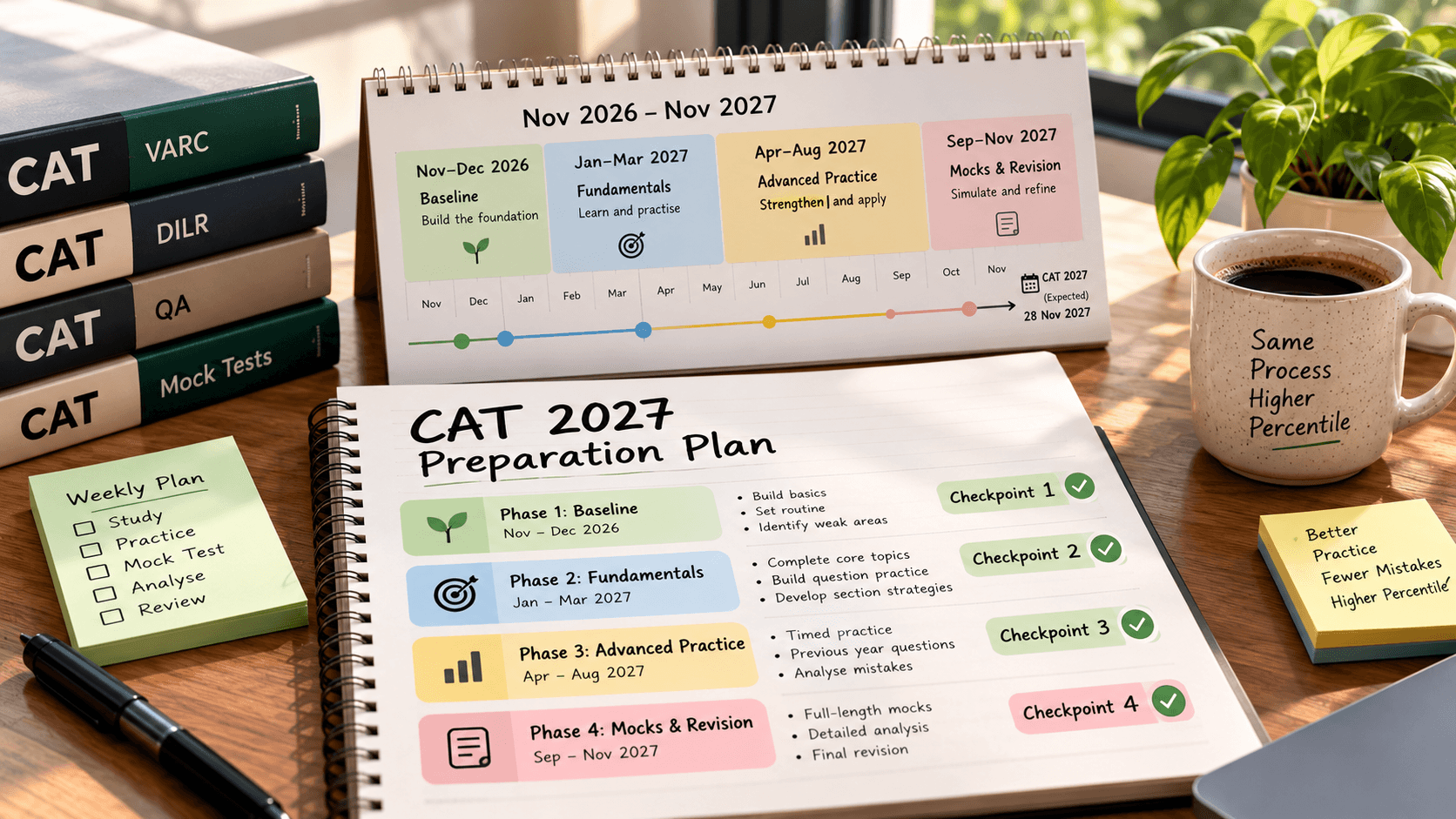
The Common Admission Test (CAT) is the entrance exam for MBA programmes at the Indian Institutes of Management (IIMs). A 99+ percentile asks for more than a long runway: it asks for weekly hours you hold through exams, jobs and festivals. About 2.58 lakh candidates appeared for CAT 2025 (Careers360), and only the top 1% reach that percentile.
The plan below is counted back from the expected exam day, with a checkpoint after every phase.
Key takeaways
- Start with a light baseline in November and December 2026, then do full-intensity work from January 2027 to the expected exam day, within a runway of 8 to 12 months from scratch.
- CAT 2027 dates are not notified. 28 November 2027 is our inference from the last-Sunday pattern, so confirm every date on iimcat.ac.in once the notification is out.
- Each phase ends in a checkpoint you can pass or fail. If you fail it, repeat that section's work before you move on.
- If you sit CAT 2026, your error log from that attempt is your baseline. Tag every mistake by cause before you start the 2027 plan.
CAT 2027 preparation: is it too early to start?
CAT 2027 preparation is too early only if you start at full intensity. Begin the baseline now, keep content-heavy work for January 2027 onward, and plan for the 8 to 12 months from scratch that our CAT 2027 FAQ recommends. The right start depends on your situation:
| You are | Start | Why |
| Pre-final or final-year student | Baseline in November and December 2026, full work from January 2027 | The baseline fits around exams. Mark semester-exam weeks on the calendar as zero-study weeks now. |
| Working professional | Baseline now, same four phases | The runway stays the same. Fewer weekly hours mean you hold the phase lengths, not shorten them. |
| Sitting CAT 2026 on 29 November 2026 | Keep an error log now, start the plan after the exam | The log becomes your baseline. |
| Starting after 28 March 2027 | Compressed path: use the six-month stages below, shortened to the weeks you have | Eight months before the inferred exam day is 28 March 2027. The six-month plan starts on 28 May 2027. If you start between the two dates, keep the stage order and shorten the fundamentals stage first. |
What is confirmed about CAT 2027, and what is only expected?
Nothing about CAT 2027 is confirmed. The facts below are for CAT 2026, as of October 2026, plus one labelled inference for 2027. Re-check all of them on the official site, iimcat.ac.in.
| Item | Status | Detail |
| CAT 2026 exam | Confirmed | Sunday 29 November 2026, convened by IIM Indore, in three sessions (Careers360, Daily Jagran) |
| CAT 2026 admit card | Confirmed | Download from 4 November 2026 (Careers360) |
| CAT 2026 registration | Closed | Opened 3 August 2026, extended from 15 September and closed 22 September 2026 (Daily Jagran) |
| CAT 2027 exam date | Expected, our inference | Sunday 28 November 2027 |
| CAT 2027 convening IIM, registration window, admit card, fees, pattern | Not notified | Will appear on iimcat.ac.in |
The inference rests on a pattern: CAT has fallen on the last Sunday of November in every cycle from 2022 to 2026, and 28 November 2027 is the last Sunday of November 2027. As of October 2026, the format is three 40-minute sections: Verbal Ability and Reading Comprehension (VARC, 24 questions), Data Interpretation and Logical Reasoning (DILR, 22) and Quantitative Aptitude (QA, 22) (Careers360). Plan on that format, then adjust when the notification arrives.
What should you do now if you are still attempting CAT 2026?
If you are still attempting CAT 2026, treat 29 November 2026 as the only exam that matters until it is over, and start the 2027 plan the day after. When the admit card is released on 4 November 2026, check it against our CAT admit card 2026 checklist. Spend the remaining weeks on 2026 content, not 2027.
Do one 2027 task: after the exam, write down within days, per section, which questions you attempted, which you skipped and where the minutes went. Memory fades quickly, and this record is worth more than any new baseline. When your scorecard arrives, add the sectional percentiles and run the retake plan below instead of starting at Phase 1.
What does a CAT 2027 preparation timetable look like, with a checkpoint for each phase?
The timetable has four phases counted back from 28 November 2027, the inferred exam day. From 1 November 2026 that is about 56 weeks, or roughly 13 months including the light baseline. Phases 2 to 4, from 1 January to 28 November 2027, are 47.4 weeks of full-intensity work: about 11 months, inside the 8 to 12 months we recommend. The week counts in the table are days divided by 7.
| Phase | Dates (weeks) | Focus | Pass test |
| 1. Baseline | 1 Nov to 31 Dec 2026 (8.7) | Untimed or sectional diagnostic; daily reading and arithmetic drills | One score per section, and the three weakest topics per section named in writing |
| 2. Fundamentals | 1 Jan to 30 Apr 2027 (17.1) | QA, DILR and VARC concepts | Every QA chapter topic-tested with each wrong answer tagged by cause; untimed DILR sets solved without looking at the solution; every wrong reading comprehension (RC) option explained in writing; Phase 1 diagnostic repeated with a higher score in every section |
| 3. Advanced practice | 1 May to 31 Aug 2027 (17.6) | Advanced topics, sectional tests, set selection | Sectional scores rising across consecutive sectional tests in every section; every section at or above your target colleges' sectional cutoff |
| 4. Mocks | 1 Sep to 28 Nov 2027 (12.7) | Full-length mocks, analysis, previous year questions (PYQs) | Every mock analysed; every error tagged with one cause; repeated error causes falling from mock to mock |
If you fail a pass test, repeat that section's work for as many weeks as it needs. A gap carried forward resurfaces in Phase 4, when you have no time left to fix it.
Phase 1. Take the diagnostic one section at a time and untimed: attempt every question you can, then record your score and the minutes you needed. A full-length mock on day one measures stress, not skill, which is why our CAT 2026 beginner guide advises against it.
Phase 2. Cover what is tested using the CAT syllabus guide, and learn arithmetic and the number system first, because they feed the rest of QA.
Phase 3. Practise above your comfort level. This is Deliberate Difficulty: sets or passages you solve easily have stopped teaching you anything. Learn to pick sets with the CAT DILR guide, and measure yourself against the sectional cutoffs.
Phase 4. Work through the CAT previous year questions and analyse every mock with the error-log method in the retake section below. Our mock analysis guide gives the short version.
What should you work on in VARC, DILR and QA during each phase?
Each section changes shape across the four phases, so train it differently in each one.
VARC. In Phase 1, read one long editorial a day and attempt reading comprehension (RC) passages untimed. In Phase 2, add para-summary and para-jumble practice, and explain every wrong RC option in writing. In Phase 3, move to timed RC sets and sectional tests. In Phase 4, take VARC inside full mocks and log the time you lose per passage.
DILR. In Phase 1, meet each set type: tables, charts, arrangements and games. In Phase 2, solve sets untimed until you can explain your method. In Phase 3, practise choosing which sets to attempt and which to leave, then solve against the clock. In Phase 4, run the same selection drill inside full mocks.
QA. In Phase 1, drill arithmetic. In Phase 2, go chapter by chapter through arithmetic, algebra, number system, geometry and modern maths, with a topic test after each. In Phase 3, move to mixed timed sets and sectional tests. In Phase 4, work through PYQs and review every mock error.
If you want material to run Phase 1 on, start with Rodha's free CAT 2027 course.
How do you prepare for CAT 2027 in six months?
A six-month plan runs from 28 May 2027 to 28 November 2027, which is 184 days or 26.3 weeks. It works only if your untimed diagnostic shows a concept gap in at most one section. Use this model split, which sums to 26 weeks:
| Stage | Dates | Weeks | Pass test |
| Merged baseline and fundamentals | 28 May to 6 Aug 2027 | 10 | Diagnostic repeated with a higher score in every section; every QA chapter topic-tested with each wrong answer tagged by cause |
| Sectional tests and set selection | 6 Aug to 1 Oct 2027 | 8 | Sectional scores rising across consecutive sectional tests in every section |
| Full-length mocks and analysis | 1 Oct to 26 Nov 2027 | 8 | Every mock analysed and every error tagged by cause |
Do not attempt this if your diagnostic shows concept gaps in two or more sections, or if you cannot hold weekly hours across the whole 26 weeks. Start the full 8 to 12 months instead. With fewer than four months left (after 28 July 2027), our crash-course options fit better than compressing this plan further.
How do you build a CAT 2027 retake plan after CAT 2026?
Tag every CAT 2026 error by cause, count the causes per section, and restart each section at the phase its biggest cause points to, not at Phase 1. Use this error log:
| Section and topic | What happened | Cause | Restart at |
| QA, number system | Wrong | Concept | Phase 2, that topic |
| DILR, second set | Skipped after a long attempt | Selection | Phase 3, set-selection drills |
| VARC, RC passage | Wrong, finished late | Speed | Phase 3, sectionals |
| QA, percentages | Wrong, method right | Careless | Phase 4, accuracy review |
The rows are examples; fill one row per mistake. A pass is every wrong or skipped question carrying exactly one cause. A fail is any row left as "don't know", because an unexplained error cannot be fixed. Different sections will usually restart at different phases. Concept errors send you back to learn, while speed and selection errors need timed practice, so reading the log correctly saves months.
How many hours a week should a student or a working professional study?
Students study one to two hours a day in the early phases, and working professionals study one to two focused hours on weekdays plus weekend sessions (our published guidance in the beginner guide and the working-professional guide). For Phases 3 and 4, set your weekly hours from the checkpoints rather than from a fixed number: take the pass test you must clear, count the weeks left, and work back to the hours that get you there.
Test your calendar with one multiplication: total hours equal your weekly hours times 47.4 weeks, the span of Phases 2 to 4. If the total cannot cover the checkpoints, start earlier. Adding hours you cannot sustain does not work.
What does a 99+ percentile actually demand?
A 99+ percentile demands weekly hours held across your whole runway, no weak section, attempts made only when your chance of being right exceeds 25%, and mock analysis as hard as the mock itself. The top 1% of the 2.58 lakh candidates who appeared for CAT 2025 is about 2,580 people (1% of 258,000, using Careers360's report of IIM Kozhikode's attendance figures).
- Held weekly hours. The plan above gives about eleven months of full-intensity work. Semester exams, appraisal cycles and festivals go on the calendar in advance. Missed weeks are not made up in November.
- No weak section. Colleges apply sectional cutoffs, so a strong QA does not rescue a weak VARC.
- Accuracy you can defend. As of October 2026, a correct multiple-choice question (MCQ) scores 3, a wrong MCQ costs 1, and type-in-the-answer (TITA) questions carry no penalty (Careers360). An MCQ attempt pays only when 3p minus (1 minus p) is above zero, so p must exceed 25%. See CAT negative marking.
- Analysis as hard as the test. A mock you do not analyse has taught you almost nothing.
A shorter runway does not shrink this work. It raises the weekly hours you must hold.
What did CAT toppers actually do, and how long did they prepare?
Their runways differ, which is why this plan checks progress by checkpoints and not by the calendar alone. Three Rodha students have published accounts of their preparation, all for CAT 2025:
- Siddhant Misra, IIM Ahmedabad, 99.97 percentile. His account is titled as an IIM Ahmedabad conversion in six months. Watch his CAT strategy.
- Shriya Yadav, IIM Ahmedabad, 99.18 percentile. Her account is titled as an IIM Ahmedabad conversion in five months on her first attempt. Watch her roadmap.
- Anupam Agrawal, IIM Bangalore, 99.91 percentile. He prepared alongside a full-time job, and his account covers his weekday and weekend plan. Watch his plan.
Read these as runways that worked for these students, not as a promise for your starting point. If you are starting from scratch, the 8 to 12 months in this plan is the safer runway, and the checkpoints tell you whether you are on it.
Where does a structured CAT 2027 roadmap help?
A structured roadmap helps when you want the classes, tests and doubt support in one place. The phases above are a method you can run on any materials. Following our Zero to Zenith approach, you measure a baseline, then pass a test at each step.
The CAT 2027 R1 Hinglish Comprehensive Batch covers QA, DILR and VARC from basics to advanced, with live and recorded classes, 30 mocks and 105 sectional tests. Hinglish is a Hindi-English mix. Ravi Prakash teaches Quant and DILR and Krishnendu Dutta teaches VARC. Rodha Buddy gives round-the-clock doubt resolution and Rodha Panchayat gives one-to-one faculty mentorship.
If one section is your gap, the subject-wise CAT 2027 R1 Quant, DILR and VARC courses cover it alone, and Rodha's free CAT 2027 course is open to start with. Price and inclusions are on the course page. For a fit question, write to contactus@rodha.co.in or call 08049368628.
Sources
- Official CAT website, iimcat.ac.in
- Careers360: CAT 2026 official notification details
- Daily Jagran: CAT 2026 registration, exam date, admit card
- Careers360: CAT 2025 attendance, 2.58 lakh candidates appeared out of 2.95 lakh registered
- Rodha: CAT 2027 R1 Hinglish Comprehensive Batch
- Rodha: CAT 2027 FAQ
- cat.rodha.co.in
- Rodha: CAT 2026 preparation for beginners
- Rodha: working-professional guide
- Rodha: mock analysis guide
Frequently asked questions
How many months do I need for CAT 2027 preparation?
CAT 2027 preparation takes 8 to 12 months from scratch. A November 2026 start gives about 56 weeks to the inferred exam day of 28 November 2027, and full-intensity work from January 2027 gives 47.4 weeks. Fewer than eight months needs the compressed plan above.
Can working professionals prepare for CAT 2027?
Yes. Working professionals follow the same four phases over the same 8 to 12 months. The difference is weekly hours: one to two focused hours on weekdays plus weekend sessions in the early phases. Hold the phase lengths and adjust the hours, not the dates.
Should I retake CAT in 2027 after CAT 2026?
Retake when your CAT 2026 error log shows mostly fixable causes (concept, speed, selection) and you can hold the Phase 3 and 4 hours. A drop year adds hours, not marks. Retaking without changing your method tends to repeat the result.
How do I prepare for CAT 2027 in six months?
Split 26 weeks from 28 May 2027 into 10 weeks of merged fundamentals, 8 weeks of sectional tests and 8 weeks of analysed full-length mocks. It suits readers with a concept gap in at most one section. Others should take the full 8 to 12 months.
When should I start taking full-length CAT mocks for 2027?
Start full-length mocks in Phase 4, from 1 September 2027, after you pass the Phase 3 sectional checkpoint. Before then, sectional tests tell you more per hour, because a full mock before the concepts are in place mostly records gaps you already know.
Will the CAT 2027 pattern or date differ from this plan?
Neither is notified. Plan on the current format of three 40-minute sections (VARC, DILR, QA) and the inferred date of 28 November 2027. Then check the notification on iimcat.ac.in and shift the phase dates to match.
Run the CAT 2027 roadmap with structured classes and mocks
The CAT 2027 R1 Hinglish Comprehensive Batch covers QA, DILR and VARC from basics to advanced, with 30 mocks and 105 sectional tests.
Related Posts

MBA19 Oct 20269 min read
CAT Score Calculation: Marks, Attempts, Accuracy and Percentile (2026 Pattern)
19 Oct 20269 min read


Ready to Take the Next Step?
Explore our programs or connect with Rodha Buddy for personalised guidance.
