
MBA (CAT + OMETs) 19 October 2026
 10 min read
Free CAT Mocks 2027: What One Free Mock Can and Can't Show
Free CAT mocks help you identify where you lose marks, but one score cannot predict your CAT percentile. Learn how to evaluate free mocks, analyse scores, use sectional tests, and plan your final six weeks before CAT 2027.
19 October 202610 min read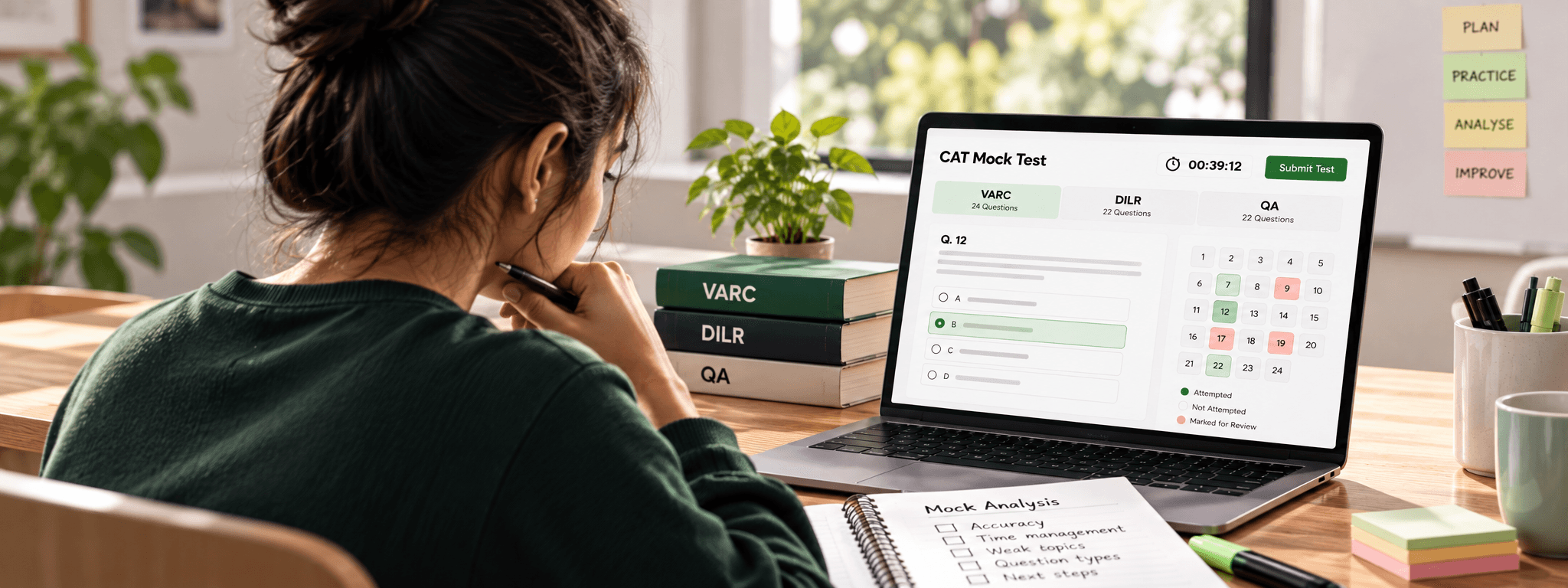
A free mock costs no money, but it costs a full sitting and the review after it, and the weeks before CAT cannot absorb many wasted ones. The CAT 2027 paper is expected to follow the recent pattern of 204 marks across 68 questions, so a single sitting produces plenty of numbers and very little certainty.
Every question you are unsure of mixes knowledge with luck, and any percentile attached to the score ranks you only against the people who sat that same mock. Two sittings of identical preparation can therefore return scores that look like progress or decline. Treat the score as a measurement with an error bar, not a rank.
The exam body has also published an official practice mock in past years, and that mock has its own timing and its own limits. Below you get what each kind of free mock shows, seven checks to run on any mock, a schedule for the final six weeks and a stop rule that tells you when another full mock has stopped teaching you anything. The aim is a decision you can defend with your own numbers.
Key takeaways
- A free CAT mock answers one question well: where you lose marks today. It cannot forecast your CAT percentile.
- Guessing alone can move a score by double digits. On our model, with 15 guessed questions, two mocks must differ by about 19 marks out of 204 before the gap means anything.
- Run seven checks before you sit any free mock: question pool, solutions, percentile pool, negative marking, difficulty, analysis report and sign-up cost.
- Drop to one full mock a week and shift your hours to sectional tests when your last two full-mock scores differ by less than the guessing margin (4.9 × √n marks, where n is the larger count of guessed multiple-choice questions in those two mocks) and the same section is lowest in both. If the gap is larger than the margin, the change is probably real, so keep going.
What free CAT mocks exist, and what does each one measure?
Four kinds of free CAT mock exist: full-length, sectional, topic and official practice. Each answers a different question. Only the full-length mock rehearses the whole paper. A mock test is a timed practice paper that follows the exam's pattern and marking.
| Kind | What it is | What it can tell you |
| Full-length | All three sections back to back | Pace, section split, attempts, accuracy |
| Sectional | One section, timed | That section's accuracy and timing |
| Topic test | One topic inside a section | Whether a fix has worked |
| Official practice | One mock on iimcat.ac.in; check the site for login terms | Interface and navigation rehearsal |
Real past CAT papers are a further free option. Sat under the real 120-minute limit with 40 minutes per section, a past paper is a full-length mock made of questions the CAT setters actually used. It carries no provider percentile, so judge it by attempts and accuracy. Our free material includes CAT papers from 2020 to 2024; the final-six-weeks plan below uses past papers in week 5.
The paper has three sections: Verbal Ability and Reading Comprehension (VARC, 24 questions), Data Interpretation and Logical Reasoning (DILR, 22) and Quantitative Ability (QA, 22). It is expected to run 68 questions in 120 minutes, 40 minutes per section, for 204 marks, as in the latest published pattern (Careers360, latest CAT pattern). The CAT 2027 notification, expected around late July 2027, will confirm section-wise counts. CAT 2027 has no official date yet. Recent editions fell on the last Sunday of November, which in 2027 is 28 November, so treat that as a planning assumption until the notification confirms it (Careers360, CAT exam dates).
When does the official CAT mock open, and what does it give you?
The official CAT mock is a free practice test on iimcat.ac.in, released in the final weeks before each year's exam. In 2025 it opened on 12 November 2025. Reports on that year's access terms differ: one news report said candidates logged in with a CAT user ID and password, while another outlet said no registration was needed. The CAT 2027 mock has no announced date or terms yet. Check iimcat.ac.in in the final weeks before the exam for both.
The 2025 version drew on past CAT questions. It ran 120 minutes with 40 minutes per section and was labelled indicative only, not the final pattern (Free Press Journal, 13 November 2025). It let candidates submit a section early to move on, which the real CAT does not allow, so it does not rehearse the section lock. Use it to rehearse the interface and navigation. Do not use its score to judge your level.
If the official mock requires a CAT login, you will need a registered CAT 2027 account to use it. In recent cycles the registration window opened in early August and closed in mid-to-late September (Careers360), so register as soon as it opens and do not leave it to the last day. If you miss registration, rely on timed past papers.
Until it opens:
- Sit one timed full-length mock with sections locked, so you practise the 40-minute limit.
- Practise moving between questions and flagging them on screen.
- Fix your section order and time split before you sit the official mock, so it tests a plan.
What free CAT mock tests does Rodha offer, and how do you start?
We offer one free full-length mock at mocks.rodha.co.in. You create a free account and start; no card is asked for. After you submit, you get an instant score, an estimated percentile and a section-wise breakdown of where time and accuracy went. We also offer free sectional and topic tests.
Our mocks run on a Tata Consultancy Services (TCS) iON-style interface, a screen layout modelled on the computer-based CAT. They lock each 40-minute section, so unused minutes cannot move forward. Sign-up steps are in our free mock access guide. The rest of our free material is in the free CAT study material hub.
How our free mock scores on the seven checks below:
| Check | Our free mock |
| Question pool and repeats | One fixed full-length paper; no published figure for question-bank size or repeats |
| Solutions | Our free study-material page says every free mock comes with full video solutions |
| Percentile pool | Estimated all-India percentile, benchmarked against other Rodha test-takers. |
| Negative marking | Applies CAT’s marking rules to MCQs and non-MCQ questions. |
| Difficulty | Designed to run 10 to 15 per cent harder than the real CAT, for free and paid mocks alike. |
| Analysis report | Instant score, accuracy, estimated percentile and a section-wise breakdown of time and accuracy; deeper SWOT-style analytics are in the paid series. |
| Sign-up cost | Free account; no payment details needed. |
The extra difficulty is deliberate. A mock that flatters your score hides gaps you still have time to fix.
One free full-length mock gives you one data point. The stop rule below compares two full-mock scores, so you need a second full mock beyond the free one before it can fire.
Start the free mock at mocks.rodha.co.in
What can one free CAT mock test tell you, and what can it not?
One free CAT mock tells you four things reliably: whether you can finish three timed sections, how you split time, how many questions you attempt, and your accuracy on the first pass. It cannot give a trustworthy percentile, a topic-level verdict or a forecast. Luck and a thin question sample sit inside every score.
What does one sitting measure?
- Pattern fit: whether you finish all three sections back to back without losing focus.
- Time split: minutes spent per section, and minutes sunk into questions you then left blank.
- Attempt count: questions attempted per section.
- First-pass accuracy: correct answers divided by attempts, before you open any solution.
Our guide to analysing CAT mocks covers the review method. If your first score is poor, read our guide to low mock scores.
Why can one score mislead you?
Because every guessed question adds noise, and the noise is large. This is our model, not an official figure.
- Marking: each question carries 3 marks, so the maximum is 68 × 3 = 204. A correct multiple-choice question (MCQ) earns +3 and a wrong one −1; see CAT negative marking.
- Blind guess: one chance in four of being right gives an expected +0.25 × 3 − 0.75 × 1 = 0 marks, with a standard deviation (SD) of √3 ≈ 1.73 marks per guess.
- Many guesses: with n guesses, the SD of one mock is 1.73 × √n.
- Two mocks: the SD of the difference is √2 times larger. About 95% of gaps fall within twice that, which is 4.9 × √n marks.
| MCQs answered on a guess (n) | SD of one mock (marks) | Gap between two mocks needed to count as real |
| 10 | 5.5 | 15.5 |
| 15 | 6.7 | 19.0 |
| 20 | 7.7 | 21.9 |
| 25 | 8.7 | 24.5 |
Illustration: guess 15 questions in each of two mocks with unchanged knowledge. In about one pair of sittings in twenty, the scores will still differ by 19 marks or more. The model assumes independent blind guesses. Partial knowledge raises the noise to as much as 2 marks per question, and mocks of different difficulty add more. Treat the table as a floor.
Why is a mock percentile only an estimate?
A mock percentile ranks your score against the people who sat that mock. Our percentile is an estimate benchmarked against Rodha test-takers. In our view, test-takers on a free mock are people who chose to sit it, so the pool is not a sample of CAT candidates. Use it for direction. The real CAT scales scores across its three slots; our CAT score vs percentile entry explains how.
What can one mock not cover?
A mock cannot test every topic. A QA section has 22 questions across several topics, so a topic may carry as few as four in one mock. A topic with four questions reads only 0, 25, 50, 75 or 100 per cent, and one answer moves it by 25 points. Use topic tests to confirm a fix, not to declare a weakness.
How do you judge a free mock test before you sit it?
Run seven pass/fail checks on any free mock before you commit a sitting to it. Each takes minutes. Rodha publishes this page, and its own free mock is one of the mocks these checks apply to; the table in the Rodha section above shows how it scores.
Does the free set hold enough questions to avoid repeats?
Test: sit two mocks from the set and note every question whose stem you have already seen, including in a past CAT paper. Pass: none repeat. Fail: any repeat. A repeat inflates accuracy and tells you nothing new.
Do the solutions teach a faster method?
Test: pick five questions you got right and read their solutions. Pass: at least one shows a quicker route or tells you when to skip. Fail: you get an answer key or one long method only.
Who is the percentile measured against?
Test: find the pool size and the group named beside the percentile. Pass: it states who sat the mock and how many. Fail: it says "all-India" with no pool. A percentile without a pool is a label.
Does it mark like CAT?
Test: check the marking against +3 for a correct MCQ, −1 for a wrong MCQ and no negative marking for non-MCQ questions (Careers360, latest CAT pattern). Pass: it matches, and the report shows marks lost to wrong answers. Fail: no deduction, or a flat total.
Is the difficulty disclosed?
Test: find where the provider states how its difficulty compares with CAT, then compare your attempts on the mock with your attempts on a timed past paper. Pass: the provider states the gap, and your attempts differ from your past-paper attempts in the direction it states. Fail: nothing stated, or attempts far apart with no explanation. A mock built harder than CAT on purpose is not a fail; an undisclosed one is, because you cannot tell whether a low score reflects you or the paper.
Does the report show time and accuracy, not only a total?
Test: open the report. Pass: you see time per question and accuracy by section. Fail: only a total score and a rank.
What does sign-up cost in money and data?
Test: note what you hand over before the first question. Pass: contact details only, no card. Fail: a card, or a trial that converts to a charge.
How should you split full mocks and sectional tests in the final six weeks before CAT 2027?
This schedule is for the final six weeks. If you are earlier in your CAT 2027 preparation, take one free full mock as a baseline, then one every few weeks, and spend the other hours on concepts and sectional practice.
Take one full mock a week in weeks 1 and 2, then up to two a week in weeks 3 to 5, and none in week 6. One rule, set out below the table, tells you when to drop back to one full mock a week and put the rest of your hours into sectionals. This is our recommendation for the final six weeks before CAT 2027. The dates below assume the exam falls on Sunday 28 November 2027, the last Sunday of the month; shift them once the CAT 2027 notification confirms the date.
| Week | Dates if the exam is on 28 November 2027 | Do | Full mocks |
| 1 | 18 to 24 October | Timed baseline mock, sections locked. Count n. Find your lowest section. | 1 |
| 2 | 25 to 31 October | Sectional and topic tests on the lowest section, then a second full mock. | 1 |
| 3 | 1 to 7 November | The CAT admit card is expected in early November, as in recent cycles. Apply the stop rule after each mock. | up to 2 |
| 4 | 8 to 14 November | Sit the official mock on the day it opens (CAT 2027 date unannounced; it opened on 12 November in 2025). Use it for interface and pacing only; leave it out of the stop-rule comparison. Add one more full mock only if the rule has not fired. | up to 2, official included |
| 5 | 15 to 21 November | Timed CAT previous year questions and sectionals. Check your lowest section against the CAT sectional cutoff. | up to 2 |
| 6 | 22 to 28 November | No new full mock. Revisit your error log and timed past-paper sections. Exam expected on Sunday 28 November. | 0 |
Stop rule (our model). Count n, the MCQs you answered on a guess, in each full mock, and use the larger of the two n values for your last two mocks. Set the band at 4.9 × √n marks. Read the gap between your last two full-mock scores against the band.
- Gap larger than the band: the change is probably real. Keep taking up to two full mocks a week.
- Gap smaller than the band: the totals cannot show whether you moved, so stop judging progress from them. If the same section is lowest in both mocks, drop to one full mock a week for pace and stamina, and spend the freed hours on sectional and topic tests for that section.
Return to two full mocks a week when your accuracy in that section across your last three sectional tests beats its accuracy in your last full mock. Guessing less narrows the band, so you see real change sooner. The rule needs two full-mock scores, so you need a second full mock beyond our one free full-length mock. Official mock scores are left out because that mock is indicative only.
Are free CAT mocks enough, or have you outgrown them?
Free mocks are enough to find your weakest section and set a plan. They are not enough as your only source of full-length practice across a first attempt. Our guidance for first-time candidates is 25 to 30 full-length mocks over the whole preparation. At 68 questions each, that is 1,700 to 2,040 questions. A free set is a diagnostic set, not a cycle.
Free is enough when:
- You need a baseline and your weakest section.
- The stop rule has fired and you still have fresh past-paper sections and sectional sets for that section.
- You are still in the concept-building months, well before the final six weeks.
You have outgrown free when:
- You have sat every free full-length mock, the stop rule has not fired, and you still gain from full-paper practice.
- Questions repeat across the set.
- The report gives no time per question.
- The percentile pool is too small to compare yourself against.
Ask us what our mock and sectional-test options contain at contactus@rodha.co.in or +91-7982212251. If you have not yet sat a full mock, sit the free one first: mocks.rodha.co.in.
Sources
- CAT official website, iimcat.ac.in
- Careers360: latest CAT pattern, marking and dates
- Careers360: CAT exam dates
- Careers360 B-school: CAT 2025 official mock test released
- Shiksha: CAT 2025 official mock to release on 12 November
- Free Press Journal, 13 November 2025: CAT 2025 official mock link activated
- Rodha mock platform
Frequently asked questions
Do I need a card to take a free CAT mock?
No card is needed for our free mock. You create a free account at mocks.rodha.co.in with contact details only, start the full-length paper straight away, and get an instant score and a section-wise breakdown of time and accuracy after you submit. No payment details are requested at any step.
Is a free mock the same as the real CAT?
No. A mock copies the pattern of three timed sections. It cannot copy the real paper's difficulty, its scaling of scores across slots or its candidate pool. Only the official mock shares the exam's own interface, and it is indicative only.
Can I rely only on free CAT mocks?
No, not for a full first attempt. Free mocks find your weakest section and set your plan. The volume of full-length practice a first attempt needs is likely to exceed what a free set holds.
When does the official CAT mock open?
The CAT 2027 official mock has no announced date. In 2025 it opened on 12 November, in the final weeks before the exam, so expect a similar window in November 2027. Check iimcat.ac.in then for the date and access terms, and sit your own timed full mock before it opens so the official one tests a plan.
Do free CAT mocks come with solutions?
Our free study-material page says every free mock comes with full video solutions. Open several after your sitting, including for questions you got right, and judge them by whether they show a quicker route or tell you when to skip, as the solutions check above describes. An answer key alone does not teach you a faster method.
Can I take a free CAT mock without registration?
Not ours: a free account is needed, and no card or payment details. For the official mock, reports on the 2025 version differ on whether a CAT login was required, so check iimcat.ac.in for the CAT 2027 terms in November 2027, and register for CAT 2027 on time so a login does not block you.
What is a good score in a free CAT mock?
No single raw score is good, because the same marks map to different percentiles after the real CAT's scaling across slots. Judge a free mock by whether you finish all three sections inside 40 minutes each, your first-pass accuracy by section, and which section is lowest. A change in score smaller than the guessing margin above tells you nothing.
Can I retake a free CAT mock?
Retaking inflates your score because you remember the questions. Use a retake only to test whether a change in your time split works, and judge progress on fresh papers, sectional tests or past CAT papers.
When should I start taking free mocks for CAT 2027?
Take one free full-length mock now as a baseline, even if you have not finished the syllabus, because it shows your weakest section and your time split. Then take one every few weeks while you build concepts, and move to a weekly full mock only in the final months before the exam.
How many mocks should I take before CAT?
In the final six weeks, take one to two full mocks a week, dropping to one a week once the stop rule fires. Earlier in your CAT 2027 preparation, one free full mock as a baseline and another every few weeks is enough. The full-cycle count is in our section on whether free mocks are enough.
Sit Rodha's free full-length CAT mock first
Create a free account at mocks.rodha.co.in to get an instant score and a section-wise breakdown of where time and accuracy went.
Related Posts
MBA19 Oct 20269 min read
CAT Score Calculation: Marks, Attempts, Accuracy and Percentile (2026 Pattern)
19 Oct 20269 min read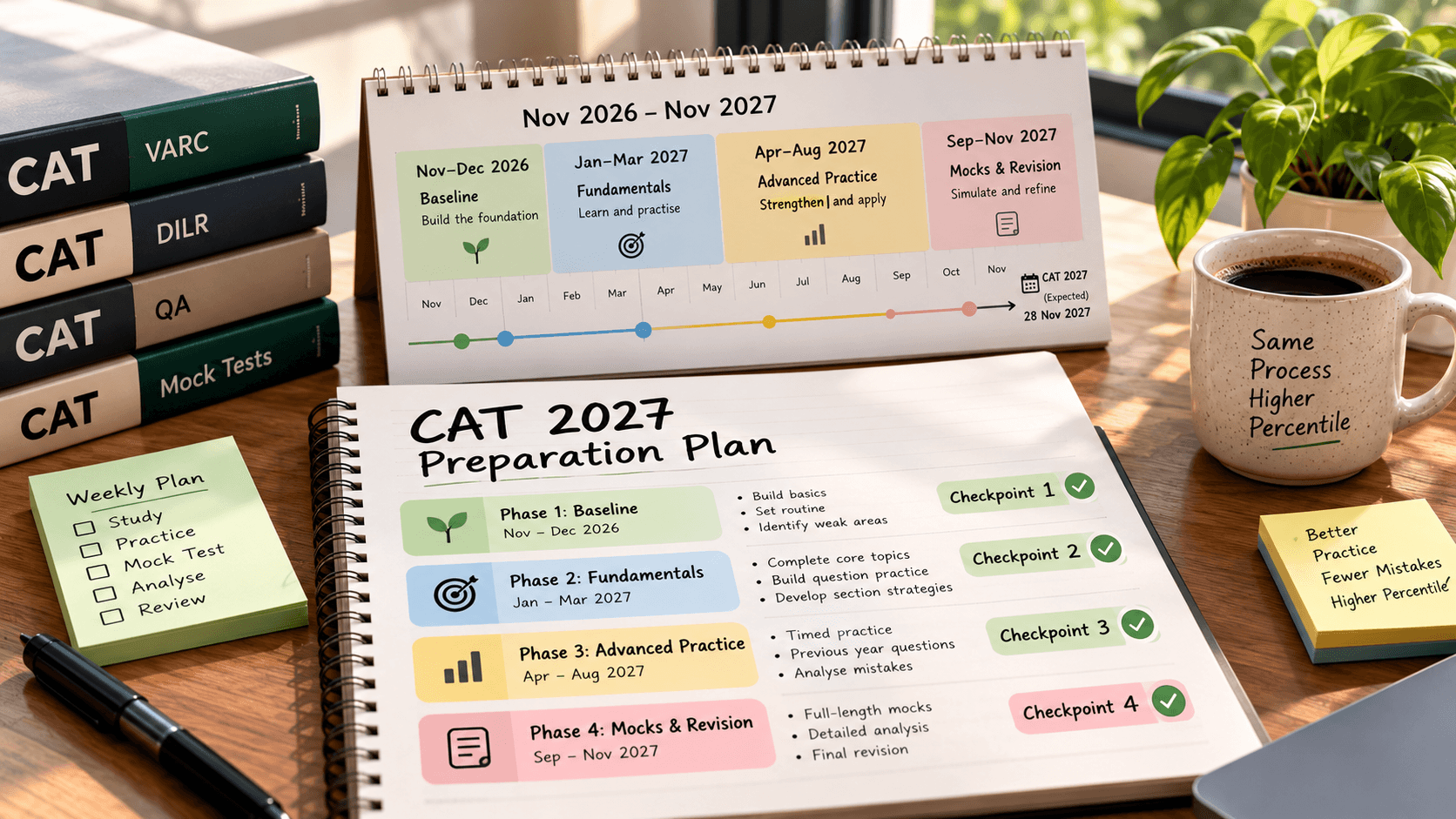

Ready to Take the Next Step?
Explore our programs or connect with Rodha Buddy for personalised guidance.
