

MBA (CAT + OMETs) 19 October 2026
 12 min read
CAT Vocabulary: Learn Words From Passages, Then Retest Them
Learn CAT vocabulary through reading comprehension passages, a five-step word-learning drill, a vocabulary ledger, and two retests to improve your understanding of words in context.
19 October 202612 min read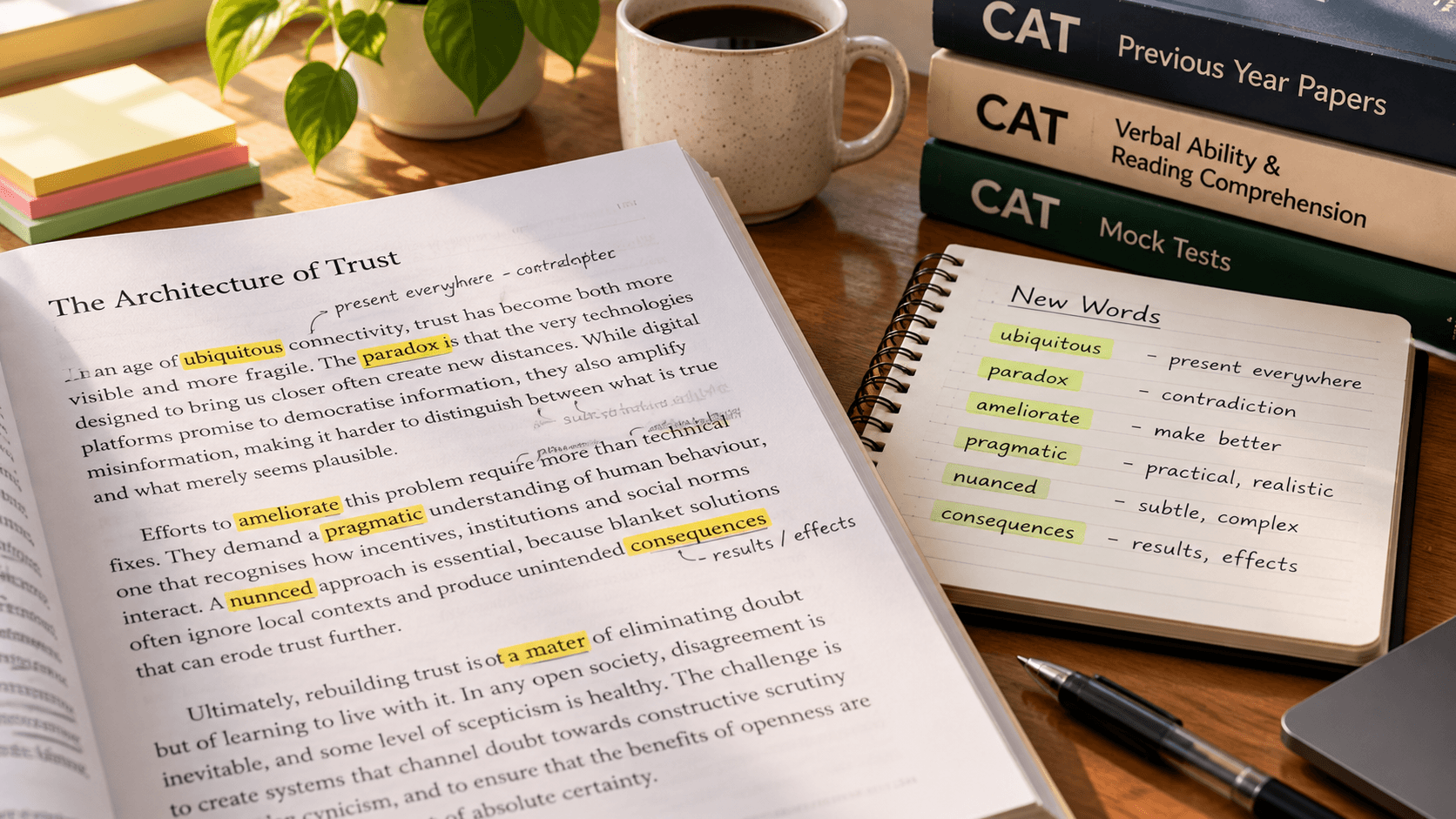
A CAT question can quote a single unusual word and still never ask you to define it. It asks what the author is doing by using that word at that point in the argument. That is the whole case for CAT vocabulary: words matter when they carry an argument, and the exam gives no credit for knowing them in isolation.
This page is for aspirants preparing for the Common Admission Test (CAT) in 2027. If you are reading this in the months after CAT 2026, you are roughly a year out, which is enough time to measure a problem and fix it. You may be more comfortable in Hinglish than in English and worried that your English is not good enough. Here, that worry becomes something you can measure.
This page has no long word list. A list trains you to recognise a word on a card, while the exam asks what a word is doing inside a paragraph. It gives you a 30-word starter set instead, picked for the role each word plays in an argument.
You get a five-step drill for one passage, a ledger to record each word, the starter set and a retest that decides whether a word is learned. The effort is daily and the retest is strict, and we will not pretend otherwise. In return, your count of unknown words per passage becomes a number you can watch fall.
Key takeaways
- Vocabulary for CAT is support for reading arguments, not a tested skill. In our CAT 2024 classification, no VARC question was a standalone synonym, antonym or definition item. 7 of 72 asked about a term, a phrase or the author’s tone.
- Skip long word lists and track unknown-word density instead. Count the share of words in a passage whose meaning you cannot state with confidence, and aim for about 1 unknown word in 50. This is a rough guide extrapolated from second-language research.
- Learn words from passages you have already read, using five steps. Mark, guess, check, record the role, reuse. Carry forward only 5 to 8 words per passage, and start with the 30-word starter set, which is grouped by tone words, argument connectors and abstract terms.
- A word is learned only when it passes two retests. You must state its role from memory after 7 days and apply the same skill in an unseen previous year question (PYQ) passage. If you meet an unknown word in the exam, mark it, read the connectors and tone around it, and return only if a question quotes it.
Is vocabulary for CAT tested directly, and is it still important?
CAT does not test vocabulary directly, but words you cannot place still cap how much of a passage you follow. In our classification of the three CAT 2024 VARC (Verbal Ability and Reading Comprehension) slots, no question was a standalone synonym, antonym or definition item, and 7 of 72 asked about a term, a phrase or the author's tone.
By slot, that is 3 of 24 questions in Slot 1, 0 of 24 in Slot 2 and 4 of 24 in Slot 3. We counted a question when its stem quotes a word or phrase from the passage and asks what it means, why the author uses it or whether it is literal, or asks for the author's tone. Question numbers are positions within each slot's 24-question VARC section.
| Slot | Question | Type |
| 1 | Q6 | Figurative label |
| 1 | Q10 | Tone |
| 1 | Q12 | Term meaning |
| 3 | Q5 | Tone |
| 3 | Q16 | Figurative label |
| 3 | Q17 | Figurative label |
| 3 | Q23 | Tone |
Slot 2 has no rows: none of its 24 questions quotes a term or asks about tone. We left out two borderline questions, Slot 1 Q18 and Slot 3 Q22. Counting both would make 9 of 72.
The papers used are the CAT 2024 VARC sections of Slots 1, 2 and 3, held on 24 November 2024. We have not found a public page that hosts them, so use your own copy if you sat or registered for CAT 2024, or practise from our free Previous Year Questions CAT course. CAT 2024 is the only paper set we have classified in full. Run the same count on the CAT 2023 and CAT 2025 papers you practise from, and compare it with ours.
So, separate two things. Standalone recall, such as plain synonyms, antonyms and fill-in-the-blank, did not appear in the CAT 2024 VARC papers. Meaning in context and tone did. For how VARC is built (24 questions in 40 minutes) and how to attack it as a whole, read our VARC preparation strategy.
Why do word lists fail, and what replaces a target word count?
Word lists fail because they train recognition, not use: you can match a word to its meaning on a card and still miss what it does in a paragraph. Replace a target word count with a measurable one, unknown-word density, the share of running words in a passage whose meaning you cannot state with confidence.
Any fixed count of words to learn is arbitrary, and we have no evidence that one predicts a CAT score. The closest research measures density. In a study of second-language readers, none gained adequate comprehension of a fiction text when 80% of the running words were familiar. At 90% and 95%, some did but most did not. The authors put the requirement near 98% (Hu and Nation, 2000), about one unknown word in 50. A 2023 replication by Kremmel, Indrarathne, Kormos and Suzuki, with non-academic readers in Sri Lanka, could not fully reproduce the original findings, so treat 98% as a rough guide.
Our inference: in a 450-word passage (450 ÷ 50), 98% leaves room for about nine unknown words. CAT passages are argumentative non-fiction, so your own count matters more than the study's. Mark, divide, and watch the number weekly.
How do you learn words from passages for CAT?
Learn words only from passages you have already read and answered. A word met inside an argument arrives with its role attached; a word on a card does not. Run these five steps on one passage:
- Mark. List every word or phrase whose meaning you cannot state with confidence. These are your unknown words. Count them and divide by the passage length; that is your unknown-word density. Ignore proper nouns and one-off technical terms.
- Guess from context. Before opening a dictionary, write the meaning you would bet on and the clue in the sentence that supports it.
- Check. Look the word up and mark your guess right or wrong. Wrong guesses are the most useful rows, because they show where context misled you.
- Record the role. Write one line on what the word does in the argument (concedes, contrasts, qualifies, signals doubt, concludes) and the tone it gives the author.
- Reuse. Write your own sentence on a different topic where the word plays the same role.
Carry forward only the 5 to 8 words that change what the author argues. Record them in a ledger with seven columns: word, source sentence, role in argument, tone, own reuse sentence, date, retest result.
What does the CAT vocabulary drill look like on a sample passage?
Run the five-step drill on this original 123-word passage; six words go into the ledger and one wrong guess is corrected.
City planners often defend congestion charges as a pragmatic fix: fewer cars, cleaner air. The argument is not frivolous. In cities that have tried charges, traffic fell, at least at first. Yet supporters tend to gloss over who pays. A flat fee is trivial for a salaried executive but punitive for a delivery rider with no alternative route. Critics are therefore right to call the charge regressive, even if their remedy, abolishing it, would merely restore the gridlock. A better design would price congestion by time and place and rebate low earners. Whatever its flaws, the charge has forced cities to treat road space as a scarce resource, not a free entitlement. The question is not whether to price roads but how fairly.
| Word | Source sentence | Role in argument | Tone | Own reuse sentence | Date | Retest result |
| pragmatic | "...as a pragmatic fix" | Frames the supporters' case as practical, which the author then tests | Neutral, guarded | The council took a pragmatic view and cut the least-used service. | Day 1 | Due day 8 |
| frivolous | "The argument is not frivolous." | Concession: grants the supporters a serious hearing before the pivot | Fair-minded | The complaint is not frivolous, but the data does not support it. | Day 1 | Due day 8 |
| yet | "Yet supporters tend to..." | Pivot connector: the real objection starts here | Turns critical | The plan looked sound. Yet no one had costed it. | Day 1 | Due day 8 |
| gloss over | "...gloss over who pays" | Accusation: supporters skip the weak point | Critical | The report glosses over the cost of delay. | Day 1 | Due day 8 |
| regressive | "...call the charge regressive" | Names the flaw, and the author endorses it ("right to call") | Agrees with critics | A flat fee is regressive because it takes more of a small income. | Day 1 | Due day 8 |
| merely | "...would merely restore the gridlock" | Qualifier that downgrades the critics' remedy | Dismissive of the remedy | Scrapping the form would merely move the delay elsewhere. | Day 1 | Due day 8 |
The wrong guess was gloss over. We guessed "explain in detail", because a gloss is an explanation. Test that against the sentence: yet signals a turn against the supporters, and an explanation turns against no one. The check gave "treat briefly or superficially". The corrected role is an accusation, and the tone is critical. The wrong guess would have made the author approve of the supporters, which is exactly the option a careless reader picks.
Where do you find passages to run the drill on?
Run the drill on passages you have already read and answered. Three sources cover it.
1. CAT previous year passages. Use the free Previous Year Questions CAT course linked above. These show you the level and the argument styles the exam uses.
2. Your own mock passages. After every mock, mark the unknown words in the passages you got wrong first, because those show where your density costs you marks. Rodha Mocks work for this, as does any full-length series you already use.
3. Editorials and long-form essays. Volume comes from reading, and our CAT VARC reading list sets out what to read. Treat anything you read as a source of passages, not a source of words: nothing enters the ledger until you can state the author's main claim in one line.
Which words should you prioritise for vocabulary for CAT VARC?
Prioritise three categories, because each one tells you what the author thinks or where the argument turns. Everything else is lower value.
- Tone and attitude words (sceptical, wry): they name how the author feels about a claim, and they appear in the answer options of tone questions.
- Argument connectors and qualifiers (albeit, notwithstanding): they show whether the next clause supports, concedes or reverses. They also decide the order in para jumbles.
- Abstract academic terms (paradigm, heuristic): they name an idea the passage then explains, so the passage itself usually teaches them.
Skip rare literary or archaic words unless an argument turns on them. That is our judgement.
Which 30 words should you start with?
This is a starter set, not a syllabus. We picked each word for the role it plays in an argument, not from a frequency count. Run each word through the five steps on a passage that uses it. Do not memorise the table.
| Category | Word | What it does in an argument |
| Tone and attitude | sceptical | Doubts a claim; the author will not endorse it |
| Tone and attitude | wry | Dry, mildly ironic; critical without anger |
| Tone and attitude | ambivalent | Mixed feelings; neither endorses nor rejects fully |
| Tone and attitude | dismissive | Treats a view as unworthy of serious attention |
| Tone and attitude | cynical | Assumes motives are self-interested |
| Tone and attitude | candid | Frank and direct, often about limits or faults |
| Tone and attitude | incisive | Sharp, penetrating analysis; usually approving |
| Tone and attitude | scathing | Harshly critical |
| Tone and attitude | measured | Restrained and balanced, not extreme |
| Tone and attitude | sanguine | Optimistic, often more than the facts justify |
| Connectors and qualifiers | albeit | Concedes a point while the main claim continues |
| Connectors and qualifiers | notwithstanding | "Despite"; grants an obstacle and moves on |
| Connectors and qualifiers | whereas | Sets two things in contrast |
| Connectors and qualifiers | nonetheless | Returns to the main line after a concession |
| Connectors and qualifiers | merely | Downgrades what follows |
| Connectors and qualifiers | ostensibly | Apparent, but the author doubts it is real |
| Connectors and qualifiers | arguably | A hedge: defensible, but contestable |
| Connectors and qualifiers | purportedly | Claimed by others, not verified by the author |
| Connectors and qualifiers | conversely | Reverses direction |
| Connectors and qualifiers | insofar as | Limits how far a claim holds |
| Abstract academic terms | paradigm | A framework of assumptions the passage usually explains, then tests |
| Abstract academic terms | heuristic | A rule of thumb; useful, but can mislead |
| Abstract academic terms | dichotomy | A split into two opposites; authors often attack a false one |
| Abstract academic terms | premise | The assumption an argument rests on |
| Abstract academic terms | empirical | Based on observation or data, not theory |
| Abstract academic terms | normative | About what ought to be, not what is |
| Abstract academic terms | tenable | Defensible; can be held against objection |
| Abstract academic terms | caveat | A warning or limit attached to a claim |
| Abstract academic terms | nuance | A subtle difference the author wants you to keep |
| Abstract academic terms | corollary | A consequence that follows from a claim |
Start with your first five rows from a passage you have already answered. Add a word from this set to the ledger only when you meet it in a passage.
What do you do when you meet an unknown word in the exam?
Do not stop. Mark it, finish the sentence and read the next one. Read the connectors and tone around it and ask whether it pushes for or against the author's claim. Return only if a question quotes it, then eliminate options that contradict that direction. For the in-passage tactic, read our guide on how to avoid re-reading a dense passage in VARC.
How do you retest a word you have learned?
A word is learned only when you can state its role in the argument and then identify it correctly in a fresh PYQ passage. Two tests enforce that, and a ledger row stays open until it passes both.
- Test 1, after 7 days. Close the ledger. Write the word's meaning and role from memory, in a new sentence. Pass: the sentence uses the word correctly in the same role. Fail: any miss sends the row back to step 5 with a new date.
- Test 2, in an unseen PYQ passage. Read a passage you have not seen. Underline the tone and connector words and write each one's role in a line. Pass: your roles match the argument as the correct answers confirm it. You do not need the same word to reappear, because the test is the skill the words serve.
Take Test 2 passages from the free Previous Year Questions CAT course linked above, or from the passages in your latest mock.
Each week, score two numbers: the share of due words that pass Test 1, and the share of roles you got right in Test 2. The pass mark is to beat last week's score on both numbers, three weeks running. Miss it and you repeat the week before adding new words. Also log your average unknown-word density; it should fall.
How much time should the daily drill take?
Run the drill once a day: one passage through the five steps for 5 to 8 words, plus any day-7 retests that fall due. Time your first three sessions, set your daily cap at the average, and hold it. The first weeks run longest because your unknown-word density is highest, and the session should shrink as density falls. If a session overruns, cut words from the ledger, not steps.
Daily is the point. The day-7 test only works if words enter the ledger on a steady schedule, and a skipped day leaves rows with nothing to test. This sits on top of your reading practice, not in place of it.
What does the drill look like from now to CAT 2027?
Run four phases. Move on when the gate is met, not when the calendar says so. Fix exact dates once the CAT 2027 date is announced, and count back from it.
| Phase | When | What you run | Gate to move on |
| 1. Baseline | First 2 weeks | Mark unknown words in 3 passages you have already answered, work out your density on each, and start the ledger | You have a density figure for 3 passages |
| 2. Build | Weeks 3 to 12 | The full daily drill, the starter set and both weekly scores | Density has fallen for 3 weeks running |
| 3. Hold | Until 8 weeks before the exam | The same drill, plus mock passages from Rodha Mocks; retest every due row | Density at or near 1 in 50 on 3 passages in a row |
| 4. Exam mode | Final 8 weeks | No new ledger rows; timed passages, Test 2 only, and the unknown-word routine from the exam section above | Not applicable |
What if your English is weak or you think in Hinglish?
You do not need an English-medium background to run this drill. You need a passage, a pen and the ledger. A high unknown-word density in the first weeks is data, not a verdict on you.
If you think in Hinglish, write the role line in Hinglish first, then restate it in English. The day-7 test must be in English, because the exam is. Begin with passages where your unknown-word count is lowest and move up as your density falls.
Where does the word drill fit in a VARC plan?
The word drill is a layer under reading practice. It helps you read arguments; it does not replace option elimination, passage practice, or mock analysis, which our VARC preparation strategy covers. That is how Rodha teaches VARC: the argument comes first, and words are support. Use the drill so that fewer unknown words interrupt the argument you are trying to follow.
Rodha's masterclass on the topic is below:
"CAT VARC Vocabulary Masterclass: Business And Economics Words For RCs | Ep 5 | Sharwari Mam Rodha" (https://www.youtube.com/embed/bIycaT_n2s0).
Start with our free CAT 2027 course, which offers free classes, strategy sessions and practice sessions in Hinglish, and run the drill beside it.
Sitting CAT 2026 in the final weeks? Do not start a new ledger now. Spend the time on timed passages from the PYQ course and apply the unknown-word routine from the exam section.
Sources
- CAT 2024 VARC question papers, Slots 1, 2 and 3, held on 24 November 2024
- Hu, M. and Nation, P. (2000), "Unknown vocabulary density and reading comprehension", Reading in a Foreign Language 13(1)
- Kremmel, B., Indrarathne, B., Kormos, J. and Suzuki, S. (2023), "Unknown Vocabulary Density and Reading Comprehension: Replicating Hu and Nation (2000)", Language Learning
Frequently asked questions
Is vocabulary important for CAT?
Yes, as support for reading, not as a tested skill. The VARC questions that touch words ask what a term or phrase means in context, or what tone the author takes. Words you cannot place cap how much of an argument you can follow.
How many words for CAT?
No fixed number of words is proven to predict a CAT score, so we do not give one. Measure unknown-word density instead: marked words divided by passage length. Research on second-language readers points to about 98% known words, roughly one unknown in 50, for adequate comprehension. Treat it as a rough guide.
How to improve vocabulary for CAT?
Learn words only from passages you have already read, using five steps: mark, guess from context, check, record the word's role in the argument, and reuse it in your own sentence. Then retest after 7 days and in an unseen PYQ passage. Nothing counts as learned until it passes both.
Do I need a word list?
No long list. A list builds recognition, but CAT questions ask what a word does in an argument. Start from the 30-word starter set above, then let your ledger of words from passages you have read replace any list. It records tone and role, which a list cannot. Keep it small: 5 to 8 words per passage.
Does CAT ask synonyms and antonyms?
No standalone synonym or antonym question appeared in the CAT 2024 VARC papers, the only paper set we have classified in full. The questions that touched words asked what a term or phrase means in context, or the author's tone. Prepare for meaning in context, and check the CAT 2023 and 2025 papers yourself.
How long should I spend on vocabulary each day?
Once a day, on one passage: the five steps for 5 to 8 words, plus whichever day-7 retests fall due. Time your first three sessions, set your cap at the average and hold it. The first weeks run longest, and the drill should shrink as density falls. Daily matters because the retest needs words entering the ledger steadily.
Is reading newspapers and editorials enough to build vocabulary for CAT?
No. Reading supplies the passages. It does not decide which words you keep or test them. Read editorials and long-form essays for volume, then run the five-step drill on passages you have finished and can summarise in one line. Without the ledger and the day-7 retest, you have no way to know whether a word stuck.
Start with Rodha's free CAT 2027 course
It offers free classes, strategy sessions and practice sessions in Hinglish, and you can run the drill beside it.
Related Posts

MBA19 Oct 20269 min read
CAT Score Calculation: Marks, Attempts, Accuracy and Percentile (2026 Pattern)
19 Oct 20269 min read


Ready to Take the Next Step?
Explore our programs or connect with Rodha Buddy for personalised guidance.
